HYROX has rapidly evolved from a niche European fitness race into a global competition sport that now drives over 175,000 participants annually across 65+ events in 11 countries — and with that explosive growth comes an unprecedented commercial opportunity for gym owners, boutique studio operators, and athletic directors. The HYROX format is deceptively simple: eight standardized functional workout stations, each separated by a 1,000-meter run, creating a total of 8 kilometers of running and 8 distinct fitness challenges that test aerobic capacity, muscular endurance, grip strength, and mental resilience in equal measure. But building a facility that properly supports HYROX training — from programming periodization to equipment procurement to spatial layout — demands a level of expertise that goes far beyond simply buying a few SkiErgs and calling it a day. At Opti-Fit, we have spent decades designing high-durability commercial fitness spaces, and in this definitive guide, we are going to walk you through every layer of what it takes to build, outfit, and program a world-class HYROX training environment that attracts dedicated athletes, drives membership revenue, and positions your facility as the go-to HYROX Affiliate Training Club in your region.
Quick Answer: What is HYROX Programming?
HYROX is a standardized fitness race format combining eight functional workout stations — SkiErg, Sled Push, Sled Pull, Burpee Broad Jumps, Rower, Farmers Carry, Sandbag Lunges, and Wall Balls — each separated by a 1,000-meter indoor run. HYROX programming focuses on developing the aerobic capacity, lactate threshold, compromised running ability, and station-specific skill efficiency required to complete all 8 rounds with maximum pacing control. For commercial facilities, implementing structured HYROX programming requires purpose-built spatial zoning, commercial-grade equipment rated for high-volume group use, and periodized training cycles that prepare athletes for race-day performance.
Understanding the 8 HYROX Stations & Equipment Specifications
Each of the eight HYROX stations presents a unique metabolic and mechanical demand. Understanding the physiological cost of each movement — and the commercial equipment required to train for it effectively — is the foundation of intelligent facility design. Below, we break down every station with the equipment specifications, movement mechanics, and minimum floor space required for a properly built training environment.
| Station | Movement Mechanics | Commercial Equipment Required | Min. Floor Space (per unit) |
|---|---|---|---|
| 1. SkiErg (1,000m) | Bilateral upper-body pulling with hip hinge; demands lat endurance, grip stamina, and coordinated breathing rhythm under progressive fatigue. | Concept2 SkiErg (PM5 monitor); wall-mounted stand recommended. Minimum 2-3 units for group classes. | 4' W x 6' D per unit (24 sq ft). Allow 3' aisle between units. |
| 2. Sled Push (50m) | Full-body horizontal drive; quad-dominant force production with trunk bracing. Weight progresses by division: Men's Pro 202kg, Women's Pro 152kg. | Commercial-grade sled with low-friction runners; 20mm+ vulcanized rubber or high-density turf surface rated at 0.40-0.55 friction coefficient. | 50m run lane x 6' W (300 sq ft per lane). Minimum 2 lanes for class throughput. |
| 3. Sled Pull (50m) | Posterior chain dominance with isometric grip demand; athletes pull sled via rope using hand-over-hand or seated row mechanics. Men's Pro 153kg, Women's Pro 108kg. | Dual-use sled compatible with push/pull attachments; heavy-duty rope with taped grip zones; identical surface specification as Sled Push zone. | 50m lane x 6' W. Can share lane with Sled Push via alternating station rotation. |
| 4. Burpee Broad Jumps (80m) | Explosive plyometric hip extension combined with chest-to-deck burpee; highly metabolically taxing; demands shock-absorbing floor substrate. | Impact-attenuating rubber flooring (minimum 12mm thickness); clear 80m marked lane. No specialized equipment; bodyweight only. | 80m lane x 6' W (480 sq ft). Can overlap with run track if surface is consistent. |
| 5. RowErg (1,000m) | Full-body synchronized pulling pattern; power-to-pace ratio management is critical. Legs-back-arms sequencing under accumulating fatigue. | Concept2 RowErg (PM5 monitor). Minimum 3-5 units; floor footprint requires 2' clearance behind for slide rail extension. | 8' L x 3' W per unit (24 sq ft). Allow 2' aisle between units, 3' behind. |
| 6. Farmers Carry (200m) | Loaded bilateral carry; grip endurance is the primary limiter. Men's Pro 2x32kg kettlebells, Women's Pro 2x24kg. | Competition-grade kettlebells (16-32kg pairs); 200m marked carry lane on anti-fatigue or rubber surface. Dumbbells as alternative training tool. | 200m lane x 6' W (1,200 sq ft). Can share perimeter running track. |
| 7. Sandbag Lunges (100m) | Loaded unilateral lower body with anterior load placement; demands hip stability, core bracing, and balance under fatigue. Men's Pro 30kg sandbag, Women's Pro 20kg. | Commercial-grade sandbags (20-30kg); 100m marked lane. Water-filled training bags acceptable for conditioning variance. | 100m lane x 6' W (600 sq ft). |
| 8. Wall Balls (100 reps) | Squat-to-press throwing pattern; quad endurance and shoulder stamina combined. Men's Pro 9kg ball to 10' target, Women's Pro 6kg to 9' target. | Wall-mounted target boards (10' and 9' lines); medicine balls (4-9kg). Reinforced wall structure or dedicated rig-mount system; minimum 8-10 balls for class rotation. | 8' W x 8' D per station (64 sq ft per athlete). 6-8 stations for group classes. |
Designing a HYROX Training Facility: Spatial Layout & Commercial Outfitting
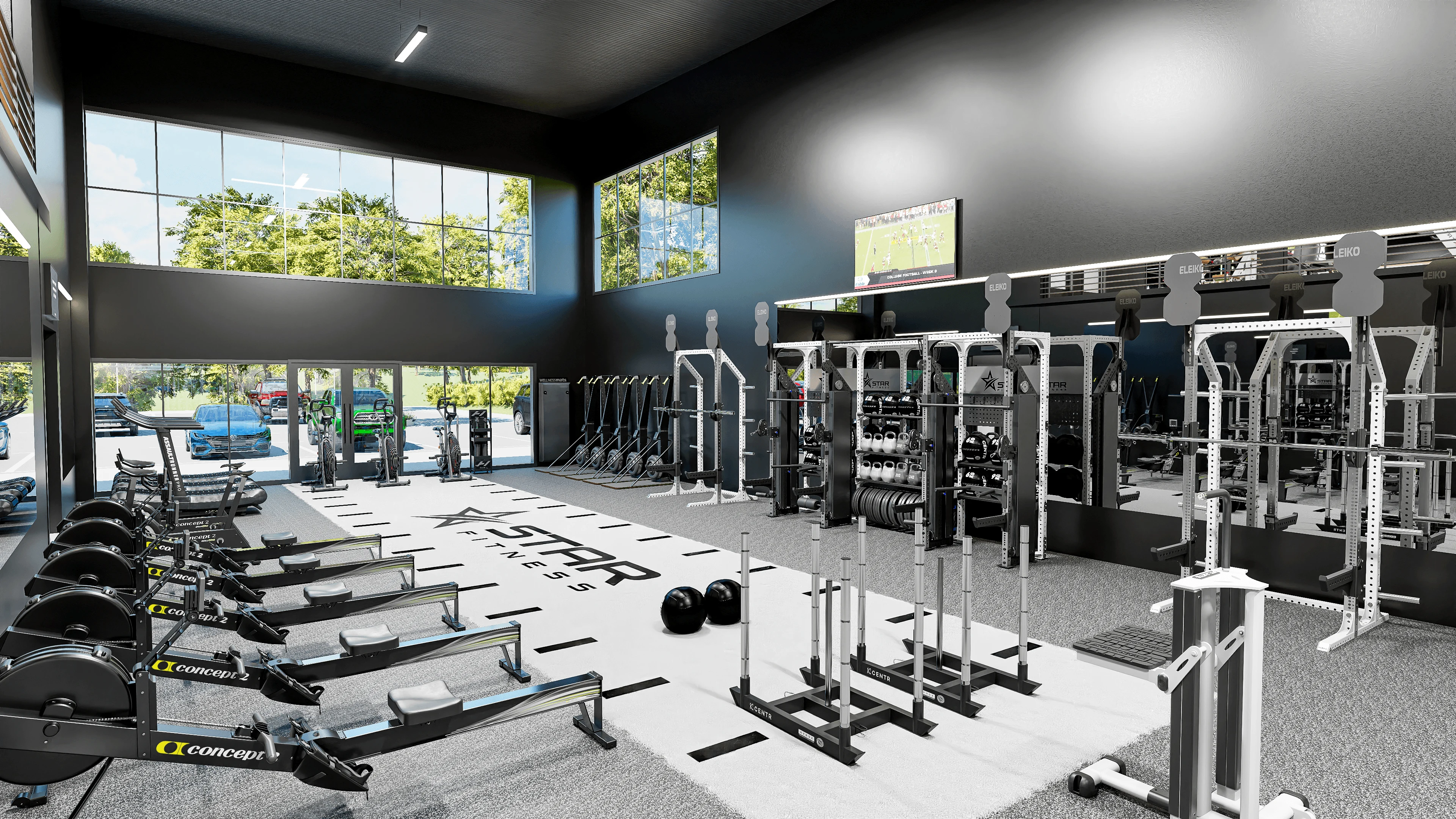
This is where Opti-Fit's core expertise — commercial fitness equipment solutions and facility design — delivers maximum value. Designing a HYROX training space is fundamentally a problem of spatial efficiency under high-volume throughput. You are not simply placing equipment on a floor; you are engineering a flow system where 20+ athletes can move through 8 stations and 8 run segments simultaneously without collision, bottlenecking, or safety hazard. Every square foot must earn its place in the revenue equation.
Zoning Strategy: The Four-Zone HYROX Floor Plan
Based on Opti-Fit's CAD floor design methodology, we recommend dividing your HYROX training space into four distinct functional zones:
Zone 1: Running Track & Perimeter Lanes
The 1,000-meter run repeats are the backbone of HYROX. Your running surface must accommodate compromised running — the ability to run efficiently immediately after maximal exertion at a station. We recommend a dedicated perimeter track surfaced with 20mm vulcanized rubber or high-density sports turf rated for both running and sled work. The track should be a minimum of 6 feet wide and ideally 8-10 feet wide if budget allows, enabling two-way traffic during peak class hours. Avoid standard commercial carpet tiles — they degrade rapidly under sled friction and create inconsistent running surfaces that increase injury risk.
Zone 2: Heavy Sled Zone
The sled push and sled pull are the most flooring-intensive stations in HYROX. Sled runners exert concentrated downward pressure and horizontal shear forces that will delaminate standard gym rubber within months. This zone requires commercial-grade turf with a minimum pile height of 12mm and a dense polyethylene fiber construction rated for 0.40-0.55 coefficient of friction — high enough to provide resistance without creating excessive drag that skews training metrics. Equally important is the subfloor: we recommend a 10mm rubber shock pad installed beneath the turf to protect the concrete slab and provide acoustic dampening, especially critical in multi-tenant or upper-floor facilities.
Zone 3: Cardio Ergometer Bay
SkiErgs and RowErgs are the anchor equipment of HYROX training. Commercial SkiErgs require wall-mounting or a dedicated floor stand, and each unit needs a minimum 4' x 6' footprint with 3-foot aisles between units for coaching access and safe mounting/dismounting. RowErgs demand more floor space — 8' length per unit with 3 feet of rear clearance for the slide rail. Power access is also a consideration: while both Concept2 units are self-powered via the flywheel, PM5 monitors require battery maintenance, and many facilities install USB charging stations nearby for athlete devices. For a class of 20 athletes, plan for at least 5 SkiErgs and 5 RowErgs to maintain reasonable rotation intervals.
Zone 4: High-Volume Wall Ball & Free Weight Area
Wall balls generate significant kinetic impact against the target surface. Your wall ball zone must use reinforced wall panels or a dedicated rig-mounted target system. Standard drywall will fail within weeks under the repeated impact of 9kg medicine balls. We recommend 3/4-inch plywood backing mounted to structural studs, faced with a commercial-grade target board that clearly marks the 10-foot and 9-foot height lines. The floor beneath should be continuous 20mm rubber — athletes will be dropping into squats 100 times per session, and the cumulative joint impact is substantial.
Spatial Efficiency: Hosting a 20-Person HYROX Class
A common question Opti-Fit receives is: "Can I run a HYROX training program in 2,500 square feet?" The honest answer is that it is tight but possible with intelligent station rotation. In 2,500 sq ft, you can accommodate 12-16 athletes by overlapping the run track with station lanes and using staggered start intervals. In 5,000+ sq ft, you can comfortably host a full 20-person class with dedicated lanes for every station and a distinct running track perimeter. Below is a representative space allocation model:
| Zone | 2,500 Sq Ft (Compact) | 5,000+ Sq Ft (Full-Scale) |
|---|---|---|
| Run Track | Shared perimeter, 6' wide | Dedicated perimeter, 8' wide |
| Sled Zone | 1 lane (push/pull share), 50m | 2 lanes (push + pull), 50m each |
| Ergometer Bay | 3 SkiErg + 3 RowErg | 5-6 SkiErg + 5-6 RowErg |
| Wall Ball Zone | 4 stations | 6-8 stations |
| Burpee/Farmers/Lunge Lanes | Overlap with run track | Dedicated lanes, no overlap |
| Max Class Size | 12-16 athletes (staggered starts) | 20+ athletes (simultaneous) |
ROI per Square Foot: The Commercial Case
When gym owners ask Opti-Fit about the return on investment for a dedicated HYROX zone, the math is compelling. HYROX athletes are among the most committed fitness consumers — they train 4-5 days per week, participate in multiple events annually, and are highly likely to purchase premium memberships, personal training packages, and branded merchandise. A well-designed HYROX training space can command membership premiums of 20-30% over standard gym rates. If your facility allocates 2,000 square feet to HYROX programming and generates an incremental $40,000 in annual membership revenue from that zone alone, you are achieving $20 per square foot in annual revenue — dramatically outperforming the industry average of $6-10 per square foot for general fitness floor space.
Periodized HYROX Fitness Programming: The 12-Week Master Plan
The physiological demands of HYROX are uniquely punishing because they combine three fitness domains that rarely overlap in traditional programming: high aerobic capacity (the 8km total running volume), high lactate threshold tolerance (the repeated station-to-run transitions), and grip/trunk endurance (Farmers Carry, Sled Pull, Sandbag Lunges). A well-designed HYROX program must systematically develop all three while teaching athletes the pacing discipline — often called AeroShed Pacing — required to avoid blowing up in the first four rounds.
Phase 1 — Aerobic Base & Station Technique (Weeks 1-4)
The foundational block builds the aerobic engine and establishes movement competency at every station. Athletes should focus on accumulating 25-35km of weekly running volume at Zone 2 heart rate (60-70% max HR), complemented by station-specific skill sessions that prioritize movement economy over intensity. Each SkiErg and RowErg session should emphasize stroke rate control — the ability to hold 500m split times at varied stroke rates (22, 24, 26, 28 spm) without drifting. Sled work is performed at 50-60% of competition weight with a focus on body position: hip angle below 45 degrees, spine neutral, heels driving through the turf.
Phase 2 — Heavy Loading & Compromised Running Intervals (Weeks 5-8)
This is the most demanding block and the one where most self-coached athletes underperform. Compromised running — the ability to transition from a maximal station effort directly into a pace-controlled 1,000-meter run — must be trained specifically. Key sessions include station-to-run brick workouts: perform 2 minutes of max-effort SkiErg immediately followed by a 1,000-meter run at target race pace, repeated for 4-6 rounds with 2 minutes rest between rounds. Sled weight progresses to 80-90% of competition weight. Farmers Carry volume increases to 400-600m total per session. Wall Ball volume builds from 100 to 200 total reps with emphasis on unbroken sets under fatigue.
Phase 3 — Peak Race Simulation & Pacing Strategy (Weeks 9-11)
Race simulation is where programming separates contenders from participants. Full HYROX simulations — all 8 stations plus all 8 run segments — should be performed once every 10-14 days during this block, with detailed split tracking at every station. Athletes learn their individual "red line" — the pace at which lactate accumulation exceeds clearance capacity — and develop the discipline to hold just below it through the first 6 rounds, reserving capacity for a final push through stations 7 and 8. Supplementary sessions focus on grip endurance maintenance (dead hangs, heavy carries, towel pull-ups) and transition efficiency — the seconds saved moving cleanly between station and run add up to minutes over a full race.
Phase 4 — Taper & Readiness (Week 12)
Volume reduces by 40-50% while intensity is maintained but abbreviated. Two light simulation sessions keep movement patterns sharp without accumulating fatigue. Nutrition and sleep protocols become the priority. Athletes should arrive at race day feeling physically fresh but neurologically primed — the skill patterns and pacing instincts built over 11 weeks should fire automatically.
Sample Weekly Schedule for Commercial HYROX Group Classes
| Day | Phase 1 (Weeks 1-4) | Phase 2 (Weeks 5-8) | Phase 3 (Weeks 9-11) |
|---|---|---|---|
| Monday | Zone 2 Run 5-7km + SkiErg/RowErg Technique (45 min) | Compromised Run Intervals: Station-to-Run Brick x 6 rounds (60 min) | Partial Simulation: Stations 1-4 + Runs (75 min) |
| Tuesday | Strength: Sled Push/Pull Technique (50-60% comp weight) + Wall Ball Volume (40 min) | Heavy Sled + Farmers Carry: 80% weight, 400m total carry volume (50 min) | Sled & Grip Endurance: 90% comp weight sled + dead hangs + carries (50 min) |
| Wednesday | Active Recovery or Zone 1 Run 4-5km (30 min) | Active Recovery: Mobility, light row (30 min) | Active Recovery: Mobility + light run (30 min) |
| Thursday | Tempo Run 5km + Burpee Broad Jump + Sandbag Lunge Technique (50 min) | Tempo Run + Wall Ball Endurance: 150-200 unbroken reps (50 min) | Partial Simulation: Stations 5-8 + Runs (75 min) |
| Friday | Full HYROX Run-Through at 70% effort (90 min) | Race Pace Simulation: 4 stations + 4 runs at target pace (60 min) | Full Simulation: All 8 stations + 8 runs at race pace (90 min) |
| Saturday | Long Run 8-10km Zone 2 (60 min) | Long Run 10-12km + Grip Accessory Work (70 min) | Long Run 8km Zone 2 + Pacing Drills (50 min) |
| Sunday | Rest | Rest | Rest |
Equipment Procurement & Commercial Outfitting with Opti-Fit
Here is the reality that too many gym owners learn the hard way: consumer-grade fitness equipment fails catastrophically under HYROX training volume. A residential SkiErg used by one person for 20 minutes a day is mechanically different from a commercial SkiErg that cycles through 15 athletes in a single class, accumulating 5+ hours of daily use. Sled runners on consumer-grade turf will tear the surface within weeks. Wall ball targets mounted on standard drywall anchors will rip out of the wall — potentially causing injury and liability.
Opti-Fit's equipment procurement process is built on three decades of commercial fitness expertise. We do not simply sell you equipment — we engineer the entire system. Our process begins with a detailed needs analysis: how many athletes are you training per session, what is your square footage, what is your budget horizon (CapEx vs. phased rollout), and what are your HYROX Affiliate Training Club goals. From there, our CAD design team produces a 3D facility layout rendering that maps every piece of equipment to its optimal zone, accounts for traffic flow during peak class hours, verifies floor load capacity for heavy sled zones, and ensures ADA-compliant clearance buffers at every access point.
Once the layout is approved, we manage procurement across our entire manufacturer network — Concept2 for SkiErgs and RowErgs, premium commercial sled manufacturers, high-density sports turf suppliers, commercial-grade kettlebells and medicine balls, and wall-mounted target systems. Equipment arrives on schedule, and our white-glove installation team handles everything from assembly to placement to final quality verification. When the last bolt is tightened, your facility is ready to run its first HYROX class — no gaps, no missing equipment, no "we're still waiting on the turf to arrive."
Essential Commercial-Grade HYROX Equipment Checklist
- Concept2 SkiErgs (3-6 units): Wall-mounted with PM5 monitors. Commercial units rated for 8+ hours daily use.
- Concept2 RowErgs (3-6 units): Floor placement with minimum 3' rear clearance per unit.
- Commercial Sleds (2-4 units): Push/pull compatible with low-friction runners. Weight plates not included — source Olympic-calibrated plates separately.
- High-Density Sports Turf (500-1,200 sq ft): 12mm+ pile height, 0.40-0.55 friction coefficient, installed over 10mm rubber shock pad.
- Competition Kettlebells (16-32kg pairs): 2-3 pairs per weight increment for class throughput.
- Medicine Balls (4-9kg): Minimum 10 balls with reinforced outer shell for high-repetition impact.
- Wall Ball Target System: 3/4-inch plywood backing, commercial-grade target boards with clear 9' and 10' height markings.
- 20mm Vulcanized Rubber Flooring: Full coverage in all station zones; interlocking or rolled format.
- Equipment Storage Racks: Vertical kettlebell racks, medicine ball shelving, sandbag storage bins.
- Sandbags (20-30kg): Commercial-grade with reinforced seams and grip handles for frequent loading/unloading cycles.
Frequently Asked Questions About HYROX Facility Design & Programming
How much space is required to launch a HYROX Affiliate Training Club?
A viable HYROX training space can operate in approximately 2,500 square feet with intelligent station rotation and staggered start intervals, supporting 12-16 athletes per class. For a full-scale operation with dedicated lanes for every station, a distinct running track perimeter, and simultaneous class throughput for 20+ athletes, we recommend 5,000 square feet or more. Opti-Fit's CAD design team can produce a 3D layout rendering that maximizes your specific square footage regardless of starting dimensions.
What type of turf is best for HYROX sled pushes?
High-density sports turf with a minimum 12mm pile height and a friction coefficient between 0.40 and 0.55 is ideal for HYROX sled work. The turf should be rated for commercial volume and installed over a 10mm rubber shock pad to protect the concrete subfloor and provide acoustic dampening. Standard gym carpet tiles or low-pile indoor turf will degrade within months under the shear forces generated by repeated sled pushes and pulls at competition weights.
How does Opti-Fit assist commercial facilities with HYROX outfitting?
Opti-Fit provides end-to-end HYROX facility solutions: needs analysis and space assessment, CAD 3D layout rendering with zone-specific equipment mapping, commercial-grade equipment procurement across our manufacturer network (Concept2, premium sled manufacturers, turf suppliers, and accessory vendors), coordinated delivery scheduling, and white-glove installation with final quality verification. We handle the entire process from initial consultation to the moment your first class steps onto the floor — ensuring every piece of equipment is correctly placed, every zone meets safety specifications, and every square foot contributes to your revenue equation.
What is compromised running and why is it critical for HYROX training?
Compromised running is the ability to run at race pace immediately following maximal exertion at a HYROX station. The transition from a 50-meter sled push or 100 wall balls into a 1,000-meter run creates a unique physiological demand — muscles flooded with lactate must immediately switch to a running gait without pace degradation. Dedicated brick workouts (station effort followed directly by run intervals) are the most effective training method for developing this adaptation, and they should be incorporated weekly during the heavy loading phase of any HYROX program.
Why can't I use consumer-grade equipment for HYROX training?
Consumer-grade fitness equipment is designed for individual home use — typically 30-60 minutes per day by one or two users. A commercial HYROX training environment cycles equipment through 15-20 athletes per class, accumulating 5-8 hours of daily use at maximal intensity. Residential SkiErgs, budget sleds, and entry-level medicine balls will fail within weeks under this volume, creating safety hazards, equipment downtime, and replacement costs that far exceed the upfront savings. Commercial-grade equipment is engineered for continuous high-volume use and backed by warranties that cover commercial environments.
Ready to Build Your HYROX Training Facility?
Whether you are launching a new HYROX Affiliate Training Club or retrofitting an existing gym with dedicated HYROX programming infrastructure, Opti-Fit is your comprehensive partner from concept to completion.
Our team provides CAD-based 3D facility renderings, commercial-grade equipment procurement, and white-glove installation — everything you need to open your doors with confidence. From the first SkiErg mounted on the wall to the final foot of turf laid in the sled zone, we ensure your facility is built for performance, durability, and revenue.
Contact Opti-Fit Today
Website: www.opti-fit.com
Phone: (916) 555-0199
Schedule a facility consultation and let's design a HYROX training space that sets your gym apart.
Schedule a ConsultationAbout the Author
Opti-Fit Editorial Team
The Opti-Fit Editorial Team brings together decades of combined experience in commercial fitness facility design, athletic performance programming, and fitness industry strategy. With expertise spanning CAD-based spatial planning, commercial equipment procurement, and periodized training methodology, our team has guided hundreds of gym owners, athletic directors, and facility managers through the process of building high-performance training spaces. From boutique HYROX Affiliate Training Clubs to full-scale university athletic complexes, we deliver the technical depth and practical insight that fitness professionals need to make confident facility decisions.